
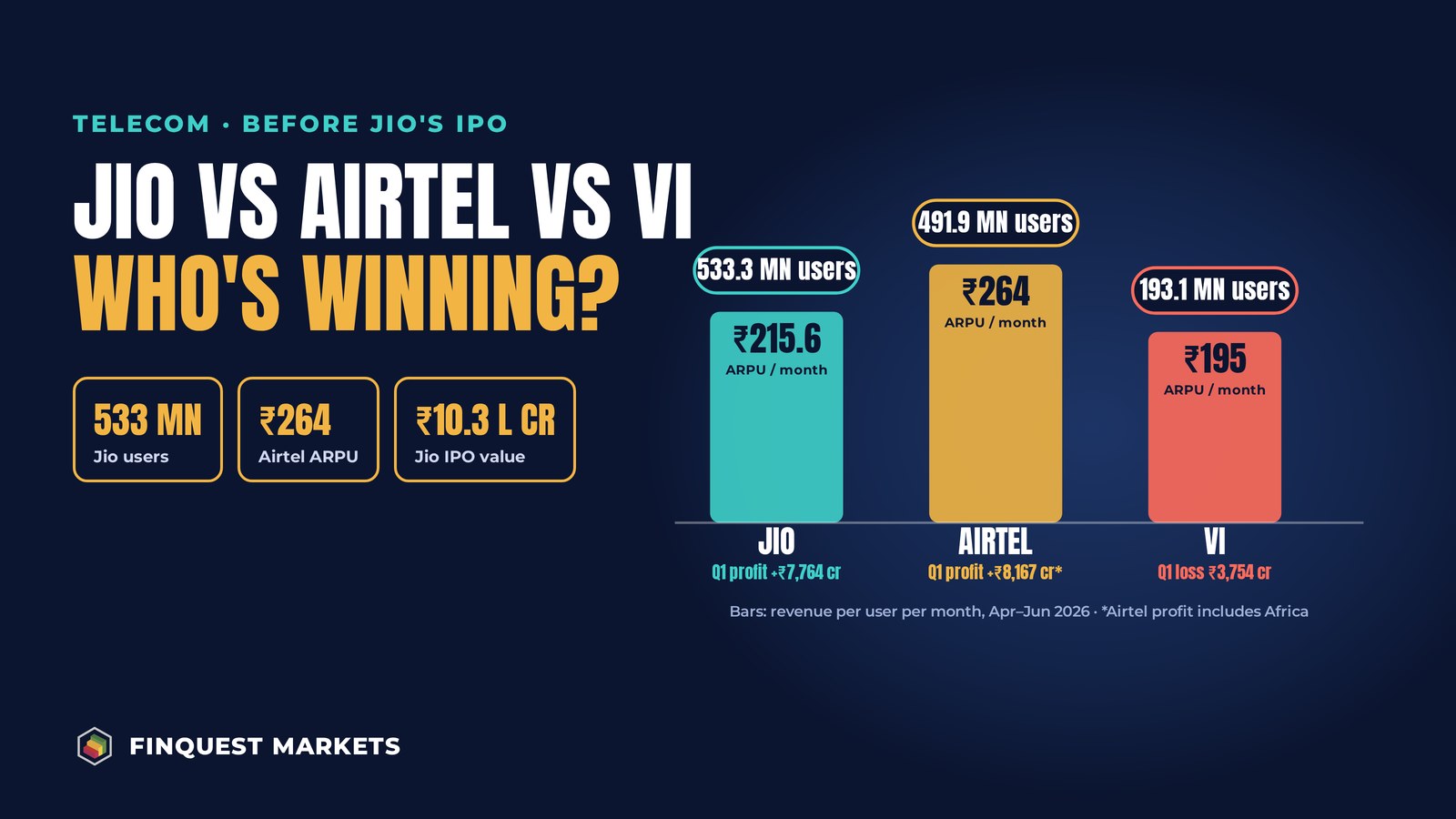
Jio Platforms opens its ₹30,213 crore IPO on 21 October, the biggest in Indian history, at a valuation of up to ₹10.3 lakh crore. Before you apply, it helps to put Jio next to the two other private players it competes with every day: Bharti Airtel and Vodafone Idea (Vi). The short version: Jio has the most users, Airtel makes the most money per user, and Vi is still fighting to survive.
The scorecard: Jio vs Airtel vs Vi
All figures are for April–June 2026 (Q1 FY27) unless noted. Users are as each company reports them.
| Metric | Jio | Airtel (India) | Vi |
|---|---|---|---|
| Users | 533.3 mn | 491.9 mn | 193.1 mn |
| Mobile market share (TRAI, Aug 2026) | 39.3% | 38.0% | 15.4% |
| Revenue per user per month (ARPU) | ₹215.6 | ₹264 | ₹195 |
| Quarterly revenue | ₹39,173 cr | ₹41,214 cr (India); ₹58,539 cr total | ₹11,689 cr |
| EBITDA margin | 53.3% | 57.4% (consolidated) | 43.1% |
| Net profit / loss | +₹7,764 cr | +₹8,167 cr (incl. Africa) | −₹3,754 cr |
| Profit growth (YoY) | +9.2% | +37% | Loss narrowed 43% |
| Home broadband share (TRAI, wireline) | 33.0% | 25.4% | 1.6% |
| Valuation | ₹10.3 lakh cr (IPO, upper band) | ≈₹10.9 lakh cr | ≈₹1.34 lakh cr |
1. Users: Jio is the biggest, but Airtel is right behind
Jio reported 533.3 million users at the end of June, adding 8.9 million in the quarter and 35 million over the year. In TRAI’s mobile data for August, Jio held 39.3% of the market against Airtel’s 38.0%, a gap of just 17 million users. Vi has 15.4% and is finally adding users again: Q1 was its first quarter of net additions since the Vodafone–Idea merger, though only 0.3 million.
Jio’s bigger lead is in 5G and home broadband. It has 285 million 5G users and 28.6 million fixed broadband customers, helped by JioAirFiber. In wireline broadband, Jio holds 33% of the market to Airtel’s 25%. Vi barely plays here.
2. Revenue per user: Airtel wins clearly
This is the most important number in Indian telecom. Airtel earns ₹264 per user per month, about 22% more than Jio’s ₹215.6. That gap exists because Airtel has more postpaid users (30 million), more people on expensive plans and a higher share of smartphone users. Vi’s ARPU jumped 10% to ₹195, but it is still the lowest of the three.
For investors, the ARPU gap cuts both ways. It shows Airtel has a better-quality customer base today. It also shows how much room Jio has to grow if it closes even half the gap through tariff hikes or by moving users to costlier plans. Each ₹10 rise in Jio’s ARPU adds roughly ₹6,400 crore to annual revenue on its current user base.
3. Profits: two cash machines and one patient
Jio made ₹7,764 crore in Q1, up 9.2%, with an EBITDA margin of 53.3%. Steady, but profit growth has slowed as 5G costs and depreciation pile up.
Airtel made ₹8,167 crore, up 37%, on revenue that grew 18.4%. Part of that comes from Africa, so the comparison with Jio isn’t exactly like for like, but Airtel’s India revenue still grew 9.7%. Its net debt fell 34.5% to ₹81,852 crore.
Vi lost ₹3,754 crore. That is a big improvement on last year’s ₹6,608 crore loss, but the Q1 number includes a ₹1,611 crore one-time gain. Strip that out and the underlying loss was about ₹5,365 crore (our calculation). Vi still owes the government about ₹1.30 lakh crore in deferred spectrum payments and ₹25,759 crore in AGR dues, against just ₹6,558 crore of cash. Its quarterly capex of ₹1,930 crore is a fraction of what its two rivals spend.
4. Valuation: Jio is priced almost exactly like Airtel
| Valuation measure | Jio (IPO) | Airtel | Vi |
|---|---|---|---|
| Market value | ₹10.3 lakh cr | ≈₹10.9 lakh cr | ≈₹1.34 lakh cr |
| Price to earnings | ≈34x (FY26 profit of ₹30,049 cr) | ≈35x | Loss-making |
| Value to annual EBITDA | ≈12x* | ≈10x | ≈14x* |
At the top of the price band, Jio is valued slightly below Airtel’s market value while making slightly less profit and growing it more slowly. In other words, Reliance is not leaving much on the table. Motilal Oswal had valued Jio at $115–118 billion in June; the IPO prices it at about $107 billion, roughly 7–9% below that.
Vi looks cheap on market value but not on enterprise value. Once you add the money it owes the government, investors are paying more per rupee of EBITDA for Vi than for Airtel or Jio. That premium is a bet that further government relief, tariff hikes and fresh funding turn it around.
Jio IPO: key details
- Price band: ₹1,065–1,119 per share
- Lot size: 12 shares (₹13,428 at the upper band)
- Issue size: ₹30,213 crore, all fresh shares, about 2.9% of the company
- Dates: opens 21 October, closes 23 October, allotment 26 October, listing 28 October (tentative)
- Use of money: repaying Reliance Jio Infocomm’s borrowings and general corporate purposes
- Quota: at least 15% for retail investors, at most 50% for institutions
Because only about 3% of Jio is being sold, the free float will be very small. That can support the share price early on, since there are few shares to trade, but it also means big index inclusions and anchor lock-in expiries (24 November and 23 January) could cause sharp moves.
Ranking by value at today’s price
This ranks how attractive each is at its current price, not which is the best company.
- Bharti Airtel: about the same valuation as Jio, but with higher revenue per user, faster profit growth, falling debt and an Africa business on top. You are paying a fair price for the best operator.
- Jio (IPO): the biggest user base and the most room to raise ARPU, plus a strong home broadband business. But it is priced like Airtel without Airtel’s profit growth, so most of the upside depends on future tariff hikes. A reasonable buy for the long term; listing gains are likely to be modest given the size of the issue.
- Vodafone Idea: improving, but still loss-making with about ₹1.56 lakh crore owed to the government. It is the highest-risk, highest-reward option of the three: if relief and tariff hikes come through, the stock can multiply; if they don’t, shareholders can be diluted heavily. Only for money you can afford to lose.
One thing works in all three companies’ favour: a three-player market where the two leaders hold 77% of users makes further tariff hikes likely. Jio’s listing gives Reliance a public price to defend, which could make it more willing to lead the next hike.
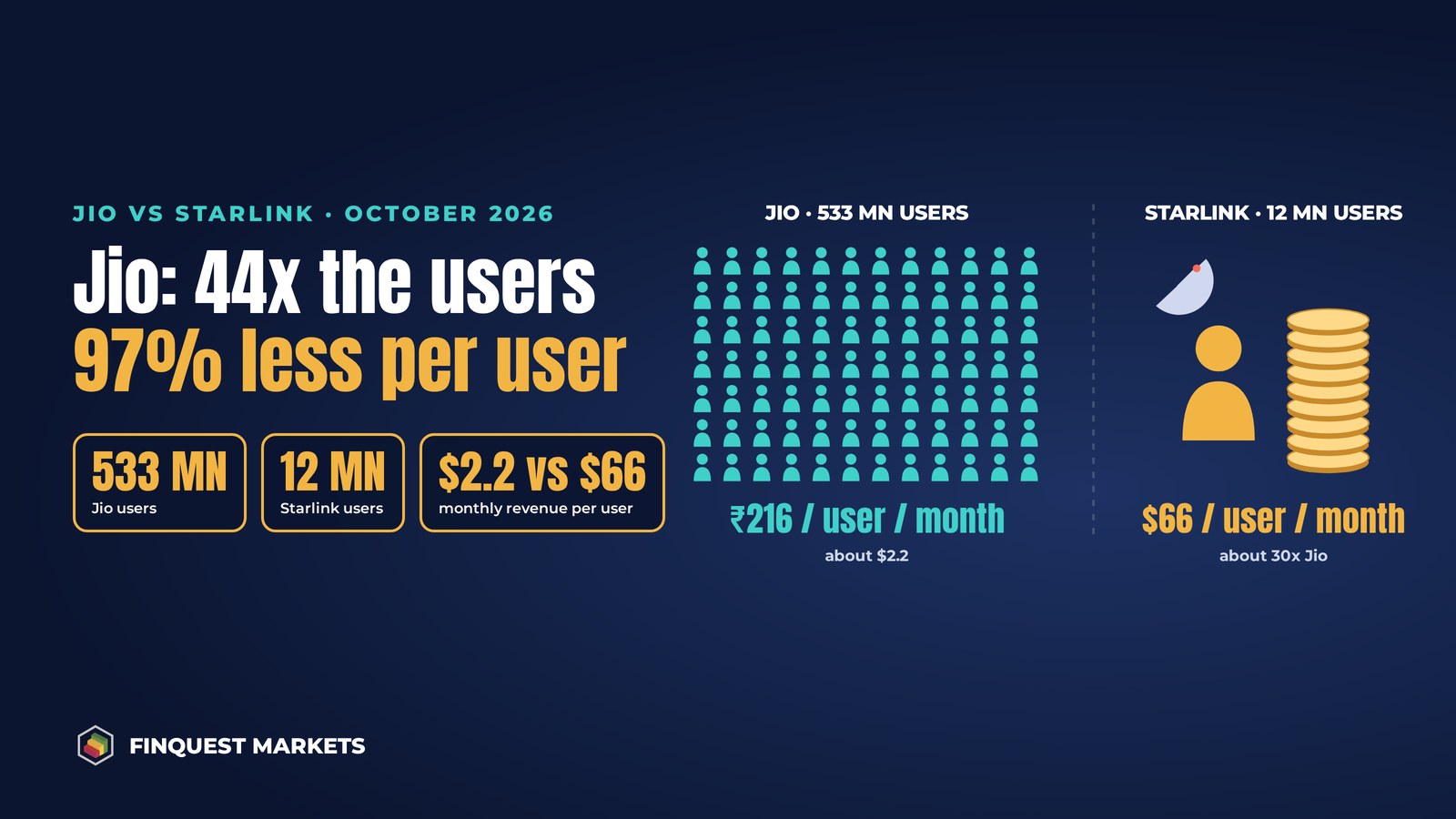
For more on how Jio’s pricing compares globally, read Jio vs Starlink: 44x the users, 97% less per user. And for why the timing of this IPO matters, see foreign investors pulling ₹52,100 crore out of Indian stocks.
FAQ
Which telecom company has the most users in India?
Jio, with 533.3 million users at the end of June 2026 and 39.3% of the mobile market in TRAI’s August data. Airtel is second with 38.0%.
Who earns the most per user?
Airtel, at ₹264 a month, followed by Jio at ₹215.6 and Vi at ₹195.
Is the Jio IPO overvalued compared with Airtel?
Not by much. At about 34 times FY26 profit, Jio is priced roughly in line with Airtel’s 35 times. It isn’t a bargain, but it isn’t stretched either.
Is Vodafone Idea profitable?
Not on an operating basis. It lost ₹3,754 crore in Q1 FY27, and would have lost about ₹5,365 crore without a one-time gain.
Sources
- Outlook Business: Jio Platforms Q1 results
- Finology Ticker: Bharti Airtel Q1 FY27 results
- Free Press Journal: Vodafone Idea Q1 FY27 results
- TelecomTalk: TRAI subscriber data, August 2026
- Groww: Jio Platforms IPO details
- NewsBytes: Jio IPO price band and valuation
- INDmoney: Jio vs Airtel valuation
Disclaimer: This article is for information and education only and is not investment advice. Finquest Markets is not a SEBI-registered investment adviser. IPO dates are tentative. Please do your own research or consult a registered adviser before investing.


Leave a Reply