
Last updated: 18 October 2026.
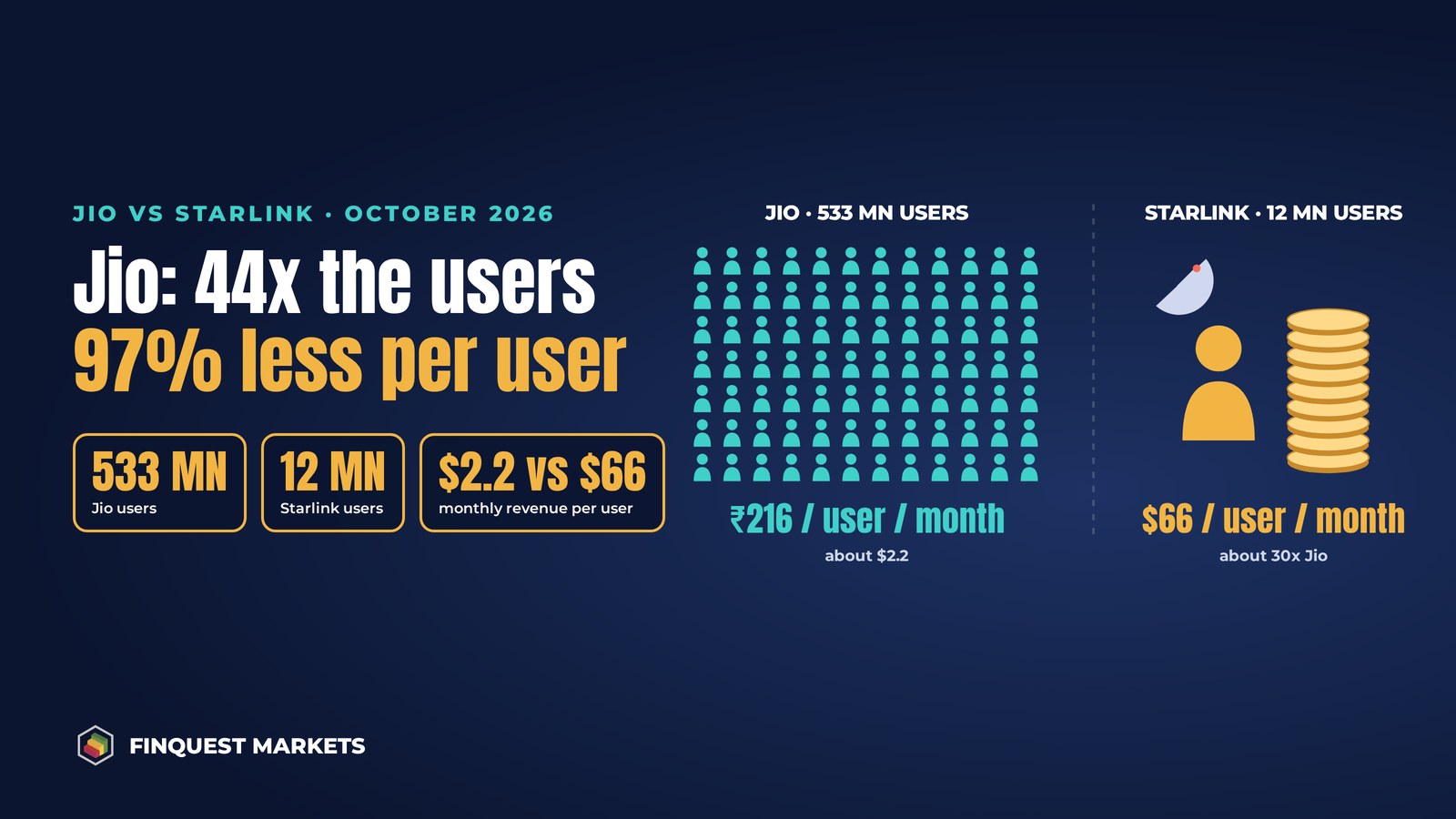
Days before Jio Platforms’ record IPO opens on 21 October, one comparison has been doing the rounds: Jio has about 44 times as many customers as Starlink, Elon Musk’s satellite internet service, yet earns about 97% less from each one.
The numbers check out. And they say a lot about how Indian telecom works, why Musk and Mukesh Ambani are sparring in public, and what investors are actually buying in the Jio IPO.
Key takeaways
- Jio had 533.3 million customers at the end of June 2026; Starlink has about 12 million worldwide. That’s about 44x.
- Jio earns about ₹215.6 (around $2.2) per user per month. Starlink earns about $66, roughly 30 times more. Jio’s figure is about 97% lower.
- Despite that gap, both businesses bring in roughly $15 billion a year.
- Starlink hasn’t launched in India yet. Musk says it will have to be priced affordably here, which would mean charging a fraction of its global average.
The comparison
| Jio | Starlink | |
|---|---|---|
| Customers | 533.3 million (India, June 2026) | ~12 million (worldwide, April–June 2026) |
| Monthly revenue per user (ARPU) | ₹215.6 (~$2.2) | ~$66 |
| ARPU trend | Up 3.3% from ₹208.8 a year ago | Down 22% from $85 a year ago |
| Approximate yearly revenue | ~₹1.47 lakh crore (~$15 billion), FY26 | ~$15 billion annualised (connectivity, H1 2026) |
| Main product | Mobile data and calls, home broadband | Satellite broadband for homes, businesses, ships and planes |
How the maths works: 533.3 million divided by 12 million is about 44. At roughly 96.7 rupees to the dollar, Jio’s ₹215.6 is about $2.23 a month, which is about 3.4% of Starlink’s $66. So Jio earns about 97% less per user, or put the other way, Starlink earns about 30 times more from each customer.
Jio’s yearly revenue figure is derived from its FY26 EBITDA of ₹76,255 crore at a margin of 51.9%. Starlink’s comes from $7.55 billion in connectivity revenue in January–June 2026, which includes business and government customers as well as households.
Why the gap is so large
1. They sell different things. Jio’s revenue comes mostly from prepaid mobile recharges, about 77% of operating revenue. That’s one SIM per person, usually on a cheap monthly pack. Starlink mostly sells a household or business internet connection, often in remote places where there’s no alternative. One Starlink dish can serve a whole family or an office, so it competes more with home broadband than with mobile plans.
2. India has some of the world’s cheapest data. Mobile data in India costs about $0.08 per GB, among the lowest anywhere. Jio itself drove prices down when it launched in 2016 with free and ultra-cheap data, and the price war that followed reshaped the industry. A Jio user now consumes about 43.7 GB a month, so Jio earns well under ₹5 per GB.
3. Incomes and markets differ. Starlink’s average is pulled up by customers in the US and other rich countries. As it expands into Africa, South-East Asia and Latin America, where it charges much less, its ARPU has been falling, from $99 in 2023 to $66 now.
4. Scale vs. premium. Jio’s model is volume: a vast network spread over hundreds of millions of users, each paying little. Starlink’s is a premium service with expensive hardware: its dishes cost $300–500, and each satellite serves a limited number of users.
Musk vs. Ambani
The comparison matters now because the two billionaires are openly feuding. Starlink holds an Indian licence but is still waiting for final security clearance and spectrum, and has not launched. Musk has accused the government of stalling Starlink to protect Jio and called Ambani “Prime Minister Ambani”; the government denies any bias.
Musk has also promised that Starlink will be priced affordably in India, writing that if it is too expensive “no one will buy it”. He suggested this would lower Ambani’s profits but not put him out of business.
The numbers explain the challenge. To compete for Indian households, Starlink would have to charge a small fraction of its $66 global average. Its global plans start around $28–50 a month (roughly ₹2,500–4,500), far above a typical Indian broadband or mobile bill.
Is Starlink a real threat to Jio?
Probably not to Jio’s core business, at least not soon. Satellite internet needs a dish with a clear view of the sky, so it can’t replace a phone’s mobile connection, which is where most of Jio’s money comes from.
The real overlap is home broadband. Jio is dominant there too, with about 42.6% of India’s fixed broadband market and around 77% of 5G fixed wireless (AirFiber) homes, and its ground-based networks are cheaper to run per user. Where Starlink could win is in remote and rural areas that fibre and towers don’t reach, plus enterprise, maritime and aviation customers. A Deloitte estimate puts India’s satellite broadband market at about $1.9 billion by 2030, small next to Jio’s revenue. Jio also has its own satellite plans, through a partnership with SES.
What it means for the Jio IPO
Jio Platforms’ IPO opens on 21 October and closes on 23 October, with a price band of ₹1,065–1,119 a share and an issue size of about ₹30,213 crore, India’s largest. It’s a fresh issue of about 3% of the company, with proceeds mainly going to reduce debt, and the target valuation is reported at around $106 billion. Listing is expected on 28 October. The grey market premium was about ₹200 a share at last report, though grey market prices are unofficial and can change quickly.
For investors, the ARPU gap cuts both ways:
- The bull case: Jio’s ARPU is low and rising. Each ₹10 increase across 533 million users adds about ₹6,400 crore of revenue a year, most of which can fall to profit because the network is already built. Users are steadily moving to 5G and home broadband plans that pay more.
- The bear case: ARPU grew only about 3.3% in the past year. Indian customers are highly price-sensitive, so tariff hikes come slowly and attract political attention. And new competition, whether from Starlink or rivals, could limit how far prices can rise.
Frequently asked questions
How many users does Jio have compared with Starlink?
Jio had 533.3 million customers in India at the end of June 2026. Starlink has about 12 million customers worldwide, so Jio has about 44 times as many.
What is Jio’s ARPU?
₹215.6 per user per month in April–June 2026, up from ₹208.8 a year earlier.
How much does Starlink earn per user?
About $66 a month on average, down from $85 a year earlier as it expands into cheaper markets.
Has Starlink launched in India?
Not yet. It holds a licence but is awaiting security clearance and spectrum. No Indian prices have been announced.
Sources
- Starlink subscribers and ARPU, Musk’s comments and the 44x comparison: TIKR
- Jio ARPU, subscribers and data usage: Angel One
- Jio revenue mix, EBITDA, broadband share and Starlink India status: INDmoney
- Jio IPO dates, price band and size: Business Standard, CNBC
- Starlink ARPU history and expansion: The Next Web
Disclaimer: This article is for information only and is not investment advice. IPO details are as reported and may change; check the official offer document before applying. Currency conversions are approximate.


Leave a Reply