
Last updated: 16 October 2026. Prices change daily; check current rates before buying.
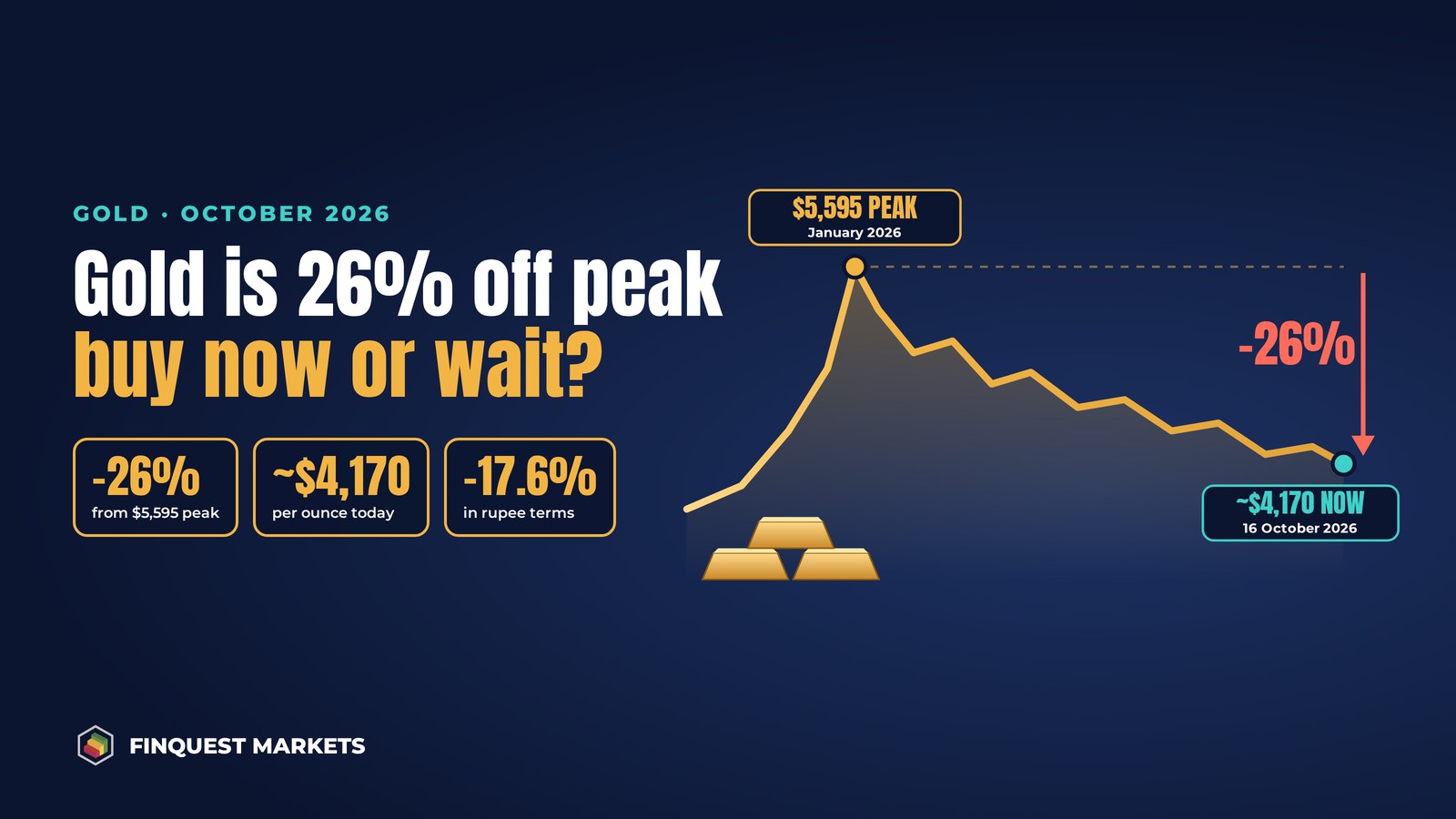
Gold hit a record of about $5,595 an ounce in January 2026. Today it trades around $4,170, roughly 26% below that peak. With Dhanteras and Diwali close, and gold often bought in India at this time of year, the obvious question is whether this is a bargain or whether prices have further to fall.
Here’s what drove the fall, the case for buying and for waiting, and a practical approach if you want to add gold now.
Key takeaways
- International gold is about 26% below its January 2026 record of $5,595 an ounce.
- In India, 24K gold is about ₹1,47,440 per 10 grams, down 17.6% from its peak of about ₹1,78,860 on 29 January. The weak rupee has softened the fall for Indian buyers.
- The main pressure is US interest rates: the Federal Reserve is raising rates again, and US bond yields are near 5.2%. Gold pays no interest, so it looks less attractive when bonds pay this much.
- Central banks are still buying heavily, which supports long-term demand.
- Nobody can reliably call the bottom. Buying in instalments over a few months is the most practical approach for most investors.
Where gold stands now
| Peak (January 2026) | Now (16 October 2026) | Fall | |
|---|---|---|---|
| International gold (per ounce) | ~$5,595 | ~$4,170 | ~26% |
| India, 24K (per 10 g) | ~₹1,78,860 | ~₹1,47,440 | ~17.6% |
| India, 22K (per 10 g) | — | ~₹1,35,150 | — |
Why has gold fallen less in India? Because India imports almost all its gold and pays in dollars. The rupee has weakened against the dollar this year (it is now near 97), which pushes up the rupee price of gold and offsets part of the global fall. We explained the rupee’s slide in what the weak rupee costs you.
Prices remain volatile. Between 11 and 15 October, 24K gold in India fell by about ₹3,980 per 10 grams before steadying on 16 October.
Why gold fell
1. Higher US interest rates. This is the big one. US inflation has picked up again, mainly because of high oil prices; September’s inflation came in at 3.7%. The Federal Reserve resumed raising rates in September, and markets now see a December hike as very likely. US 10-year bond yields are around 5.2%, near their highest in about two decades. When safe bonds pay that much, gold, which pays no interest, becomes less attractive, especially to large investors.
2. A stronger dollar. Gold is priced in dollars, so a stronger dollar makes it more expensive for buyers elsewhere and tends to push the dollar price down.
3. Investors taking profits. 2025 was gold’s best year since 1979, and it kept rising into January 2026. After a run like that, some investors sold. Gold exchange-traded funds saw about 45 tonnes of outflows in April–June 2026, though flows have shown signs of stabilising since July.
The case for buying now
- Central banks keep buying. Central banks bought a record 289 tonnes in April–June 2026, up 62% from a year earlier, according to the World Gold Council as cited by Tata Mutual Fund. A survey found 45% of central banks plan to add to their gold reserves over the next year. This steady demand puts a floor under prices.
- The fall looks cyclical, not structural. Tata Mutual Fund’s October outlook argues gold’s drop reflects temporary factors like yields and the dollar, not weaker underlying demand. Chinese gold imports have already passed 1,000 tonnes this year, more than all of 2025.
- Risks haven’t gone away. Tensions in the Middle East, US-China rivalry and worries about US government debt are the kind of things that tend to send investors back to gold.
- It’s already much cheaper. Anyone buying today pays about ₹31,000 less per 10 grams of 24K gold than at the January peak.
The case for waiting
- More rate hikes may be coming. If the Fed raises rates again in October or December, yields could rise further and keep pressure on gold. Some analysts, such as Fawad Razaqzada of Forex.com, see near-term risks tilted to the downside while the dollar is strong, even though they expect an eventual recovery towards $4,500–4,700.
- The rupee cushion could reverse. If the rupee recovers, Indian gold prices could fall more than global prices.
- Gold is still far above where it was. Even after the fall, gold is around the same level as a year ago and well above its pre-2025 prices. It isn’t “cheap” by long-term standards; it’s cheaper than a very high peak.
So, buy now or wait? A practical answer
Trying to buy at the exact bottom rarely works; nobody knows whether gold’s next 10% move is up or down. A more reliable approach is to spread your purchase over several months. Tata Mutual Fund gives the example of investing ₹3 lakh in six instalments of ₹50,000 rather than all at once. If prices fall further, later instalments buy more cheaply; if they rise, you’ve already bought part of your position.
A few other rules of thumb:
- Keep gold a modest part of your portfolio. Gold is a diversifier and a hedge, not a growth engine. Many financial planners suggest keeping it to a small share, often around 5–10% of investments.
- Don’t sell in panic if you already own gold. If you bought near the peak, the question is whether gold still fits your plan, not whether you can get your money back next month.
- Separate jewellery from investment. If you’re buying jewellery for Diwali or a wedding, today’s prices are far better than January’s. But jewellery carries making charges and 3% GST, so it’s an expensive way to invest.
Best ways to invest in gold
| Option | Good for | Watch out for |
|---|---|---|
| Gold ETFs | Low costs, buy and sell on the stock exchange like a share | Needs a demat account; small fund expense ratio |
| Gold mutual funds | Monthly SIPs without a demat account | Slightly higher expenses than ETFs |
| Existing Sovereign Gold Bonds | Pay 2.5% interest a year on top of the gold price | Bought on the stock exchange; trading can be thin and prices may differ from gold’s |
| Digital gold | Very small amounts through apps | Not regulated by SEBI; check the provider and charges carefully |
| Coins and bars | Physical ownership | Storage, purity checks and dealer spreads |
| Jewellery | Personal use | Making charges and 3% GST make it a poor investment |
On tax, under current rules, gains on gold ETFs held for more than a year and on physical gold or gold funds held for more than two years are taxed at 12.5% as long-term capital gains. Shorter holdings are taxed at your income tax slab rate.
Frequently asked questions
How much has gold fallen from its peak?
International gold is about 26% below its January 2026 record of around $5,595 an ounce. In India, 24K gold is about 17.6% below its peak of roughly ₹1,78,860 per 10 grams.
Why is gold falling in 2026?
Mainly because the US Federal Reserve is raising interest rates and US bond yields are near two-decade highs, which makes non-interest-paying gold less attractive. A strong dollar and profit-taking after a huge 2025 rally have added to the pressure.
Is it a good time to buy gold for Diwali?
Prices are well below January’s peak, which helps buyers. But prices could fall further if US rates keep rising. Buying in instalments rather than all at once reduces the risk of bad timing.
What is the best way to invest in gold in India?
For most investors, gold ETFs or gold mutual funds are the simplest and cheapest options. Jewellery is better treated as consumption than investment because of making charges and GST.
Sources
- 26% fall, Tata Mutual Fund outlook, central bank buying and staggered-investing example: Business Standard
- Indian gold rates and recent fall: Goodreturns
- India record price: RatesToday
- US inflation, Fed outlook and analyst view: Discovery Alert, SpinDepth
- Recent spot prices: Fortune
Disclaimer: This article is for information and education only and is not investment advice. Gold prices are volatile and can fall further. Consult a SEBI-registered investment adviser before making investment decisions. Tax rules may change; check the latest position before investing.

Leave a Reply