
Last updated: 14 October 2026.
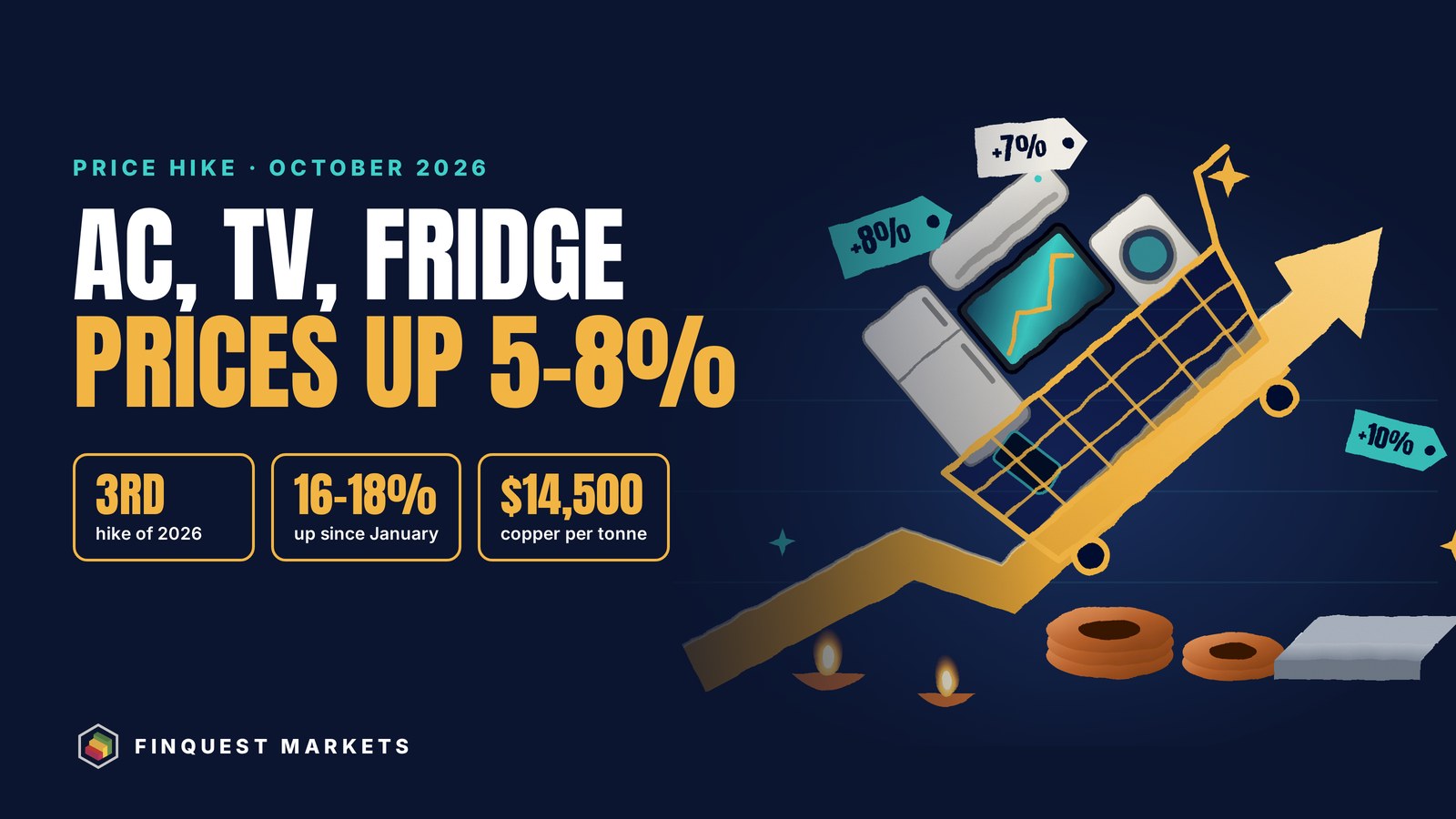
If you were waiting for Diwali sales to buy an air conditioner, a new TV or a fridge, the sticker price has already moved against you. Most large appliance makers raised prices by 5–8% from 1 October 2026, and a few went as high as 10%. It is the industry’s third price increase this year, and it takes the cumulative rise in several categories to roughly 16–18% since January.
Here is who raised prices and by how much, why it is happening, what it means in rupees, and how the hike plays out for the listed companies behind these brands.
Key takeaways
- Appliance prices rose 5–8% from 1 October, the third round of hikes in 2026. ACs saw the steepest increases.
- Cumulative increases in several categories are now around 16–18% since January.
- The main causes are costlier metals (copper is near $14,500 a tonne, up from $8,000–9,000 last year), a weak rupee, and higher freight and energy costs linked to the West Asia conflict.
- Phones and laptops are rising for a different reason: a global memory-chip shortage. Smartphone prices in India rose about 16% on average in the first half of 2026.
- For a ₹40,000 AC, an 8% hike means about ₹3,200 more. Festive discounts and no-cost EMI offers will soften, but likely not cancel, the increase.
How much have prices gone up, brand by brand?
The increases announced or reported for October differ by brand and product:
| Brand | Product | Reported increase |
|---|---|---|
| Blue Star | Air conditioners | Up to 8% (5–8% on ACs and deep freezers) |
| Daikin | Air conditioners | 6–10% (8–10% from 16 September) |
| Voltas | Room air conditioners | 5–7% |
| LG Electronics | Air conditioners | 5–7% |
| Godrej Appliances | Appliances | 4–6% |
| Haier | Room ACs; TVs and washing machines | About 5% on ACs; 2–3% on TVs and washing machines |
| Bosch Home Comfort (Hitachi ACs) | Air conditioners | About 5% |
| Samsung | 43-inch to 75-inch TVs | ₹1,000 to ₹10,000 per model |
| Super Plastronics (Thomson, Kodak) | TVs | About 7% |
By category, industry estimates put the October increase at about 5–8% for ACs, 3–4% for washing machines and up to 3% for most LED TVs, with some TV brands going higher. Individual models can move by more than the headline figure. One widely reported example: a Whirlpool 235-litre triple-door fridge went from ₹25,790 to ₹28,490 by September, a rise of about 10%.
Why are appliances getting costlier again?
1. Metals. ACs and fridges are full of copper (in the cooling coils and compressor motors), steel (in the body) and aluminium. Copper has climbed to about $14,500 a tonne, compared with $8,000–9,000 a year ago, and steel and aluminium are also dearer. That makes cooling products the worst hit, which is why AC hikes are the largest.
2. Crude oil and plastics. Plastic parts and resins are made from crude oil derivatives. With Brent near $107 a barrel this week, those inputs cost more, and so do freight and energy.
3. The weak rupee. India imports a large share of appliance components, including compressors and electronics, and pays for them in dollars. With the rupee near 97 to the dollar, every imported part costs more (we explained what the weak rupee costs you earlier this week).
4. The West Asia conflict. The prolonged conflict has pushed up commodity, shipping and energy costs at the same time. Manufacturers say they absorbed part of the increase earlier in the year but can no longer do so.
The timing matters. Navratri and Diwali account for an estimated 25–30% of a year’s consumer-durables sales, so companies are raising prices at the moment demand is strongest, and then using festive offers to keep buyers coming.
Phones and laptops: a separate squeeze
Smartphones and laptops are getting costlier for a different reason: memory chips. Demand for AI data centres has soaked up global supply of DRAM and flash memory, and memory makers are prioritising those higher-margin AI orders.
- Smartphone prices in India rose about 16% on average in the first half of 2026, according to Counterpoint Research. Phones under ₹10,000 rose the most, by around 32%, because memory is a bigger share of their cost.
- India’s average smartphone selling price reached a record $318 in April–June 2026.
- IDC expects phone prices could rise another 7–10% if component costs keep climbing, and Counterpoint does not expect memory prices to ease before 2028.
- Laptop prices from major brands such as Dell, HP and Lenovo have reportedly risen 15–30% this year.
What it means in rupees
| If the product cost… | +5% | +8% | +17% (rise since January) |
|---|---|---|---|
| ₹20,000 (washing machine) | ₹1,000 more | ₹1,600 more | ₹3,400 more |
| ₹40,000 (1.5-ton split AC) | ₹2,000 more | ₹3,200 more | ₹6,800 more |
| ₹60,000 (large TV or double-door fridge) | ₹3,000 more | ₹4,800 more | ₹10,200 more |
The last column is a rough guide to how much more the same product costs compared with January, using the midpoint of the 16–18% industry estimate. Actual increases vary by brand and model.
Should you buy now or wait?
There is no sign of prices falling soon: metal costs, the rupee and memory-chip prices all point the other way. A few practical points if you are planning a purchase:
- Look for old stock. Retailers often still hold units bought at pre-hike prices. Asking a store for older stock, or checking the manufacturing date online, can save you the latest increase.
- Compare the final price, not the discount. A festive discount applied to a higher list price can leave you paying the same or more than before. Check the price history before buying.
- Use no-cost EMI carefully. Brands such as LG are leaning on zero-interest EMI and extended warranties to keep sales going. These spread the cost but do not reduce it, and processing fees can add up.
- Consider a tier down. Analysts expect some buyers to shift to mid-range models or smaller brands that have raised prices less.
What it means for consumer-durables stocks
Shares of Voltas, Blue Star, LG Electronics India, Amber Enterprises and IFB Industries rose when the October hike was reported on 28 September, as investors read it as a sign the companies can pass on higher costs and protect margins. Voltas, for example, climbed about 1.7% that day and Blue Star about 1.4%.
The risk is volume. A third hike in one year, landing right before the busiest selling season, could push buyers to delay purchases or trade down. That matters most for AC makers like Voltas and Blue Star, which are heavily exposed to room ACs. Voltas traded around ₹1,041 on 13 October, roughly a third below its 52-week high of ₹1,582.50, which suggests the market is already cautious about demand.
The real test comes with the October–December quarter results in January and February, when companies report how many units they actually sold during the festive season. Margins can hold up even if volumes slip, but a sharp drop in volumes would weigh on both.
Frequently asked questions
Are AC prices increasing in October 2026?
Yes. Most AC brands raised prices by about 5–8% from 1 October 2026, with Daikin reporting increases of up to 10%.
Why are electronics prices going up in India?
For appliances, mainly higher copper, steel and aluminium prices, a weak rupee and higher freight and energy costs. For phones and laptops, a global shortage of memory chips driven by AI data-centre demand.
How many times have appliance prices risen in 2026?
Three times. The October increase is the third round this year, taking the total rise in several categories to around 16–18% since January.
Will prices come down after Diwali?
Unlikely in the near term. The cost pressures behind the hikes, including metal prices, the rupee and memory-chip shortages, have not eased, and memory prices are not expected to fall before 2028.
Sources
- October hike and category estimates: Sentinel Assam, Entertales
- Brand-wise increases and Samsung TV prices: ET via inkl, News24
- Copper prices and the Whirlpool example: Outlook India
- Cumulative 16–18% rise and demand risks: Sahi, Kotak Neo
- Stock moves on 28 September: Business Today, Zee Business
- Smartphone prices: The Pioneer (Counterpoint), Bhaskar English (IDC)
- Laptop prices: Business Today
- Crude oil this week: HDFC Sky
Disclaimer: This article is for information only and is not investment advice. Prices quoted are reported increases and vary by model, retailer and city. Check current prices before buying.

Leave a Reply