
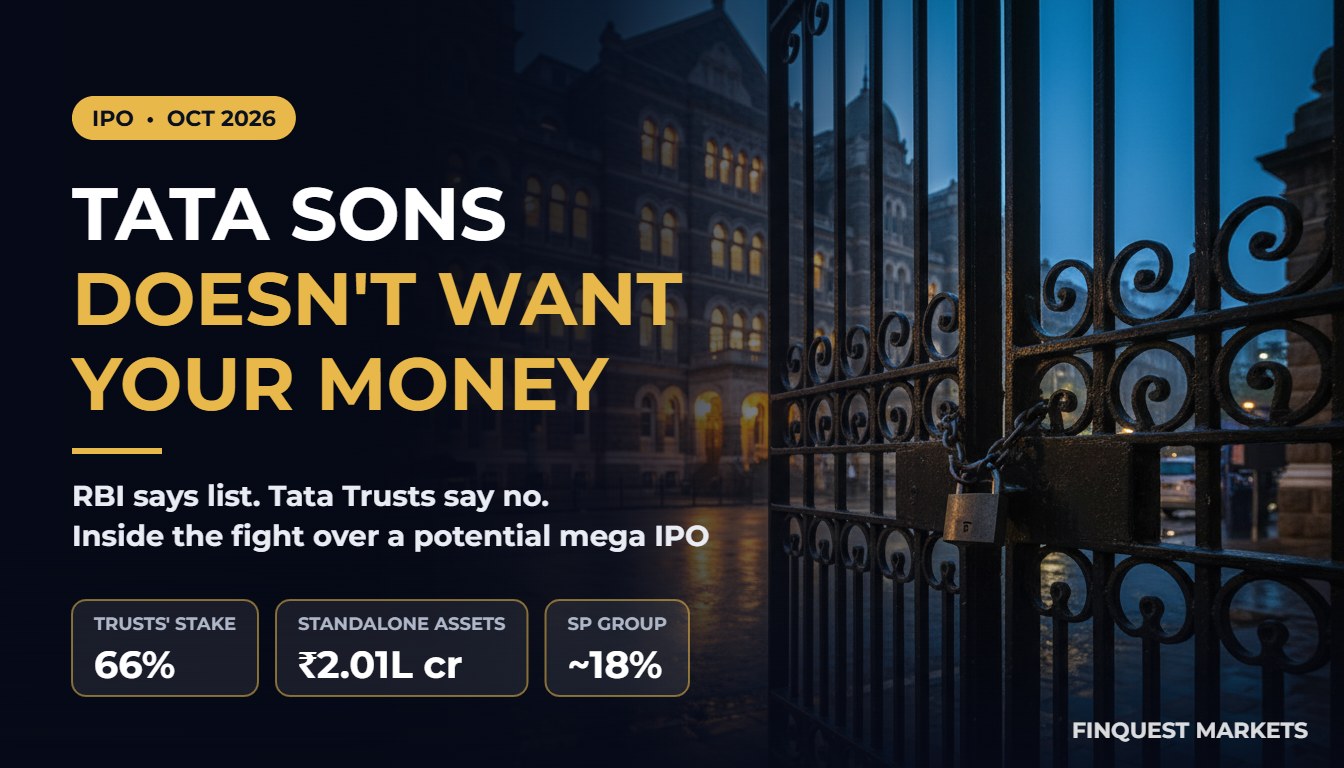
A year ago, the Tata group priced the Tata Capital IPO below what big institutions were willing to pay, specifically to pull in small investors. Now the group’s own parent, Tata Sons, is doing the opposite: fighting a regulator’s order to sell shares to the public at all.
In September 2026 the Reserve Bank of India rejected Tata Sons’ application to give up its registration as a core investment company, the route it had been using to avoid a mandatory listing. A week later the Tata Sons board voted to take steps towards listing. But Tata Trusts, which own about 66% of the company, are still trying to keep it private, most recently with a plan to merge two operating companies into it. Here’s why Tata doesn’t want your money, what it has tried, and what this means if you hold Tata stocks.
Key takeaways
- The rule: RBI classed Tata Sons as an Upper Layer NBFC in September 2022. Such companies must list within three years. The deadline, 30 September 2025, has passed.
- The rejection: RBI turned down Tata Sons’ plea to deregister in a letter dated 11 September 2026, closing its main escape route.
- The split: The Tata Sons board backed steps to list on 17 September. Tata Trusts, led by Noel Tata, oppose it. The Shapoorji Pallonji (SP) group, with about 18%, wants it.
- The new plan: On 28 September the Trusts proposed merging Tata Electronics Systems Solutions (TESS) and Tata Consulting Engineers (TCE) into Tata Sons so it no longer counts as a financial company. It needs the board’s and RBI’s approval.
- For investors: No Tata Sons IPO has been announced: no date, price or size. Listed Tata stocks that hold Tata Sons shares swing on every headline.
Why the RBI wants Tata Sons listed
Tata Sons is the holding company of the Tata group. It owns large stakes in TCS, Tata Motors, Tata Steel, Tata Power, Air India and dozens of other companies. Because most of its assets are investments in group companies, the RBI treats it as a core investment company (CIC), a type of non-banking financial company (NBFC).
In 2021 the RBI sorted NBFCs into layers by size and risk. The biggest ones, in the Upper Layer, face tighter rules, including a requirement to list on the stock exchanges within three years. Tata Sons was put in that layer in September 2022, alongside lenders like Bajaj Finance and Shriram Finance.
The RBI tightened this further in June 2026: any NBFC with assets of ₹1 lakh crore or more now sits in the Upper Layer automatically. Tata Sons’ standalone assets were about ₹2.01 lakh crore at March 2026, roughly double the bar. When the RBI reclassified it in August, Tata Sons was reportedly the only unlisted company left on the 17-name list. Government-owned NBFCs such as REC and PFC are exempt from the listing rule; a private company like Tata Sons is not.

Why Tata doesn’t want your money
Most companies list because they need capital or their owners want to cash out. Tata Sons’ controlling shareholder wants neither. These are the main reasons the Trusts have resisted.
1. It doesn’t need the cash
Tata Sons is debt-free. It repaid more than ₹21,000 crore of borrowings in FY2024, partly by selling about ₹9,362 crore of TCS shares, precisely so it could argue it no longer used public money. Its income comes mainly from dividends paid by group companies, led by TCS. ISB professor Sougata Ray told the Financial Times last year that the family and Trusts have no compulsion or incentive to list, since they need neither to unlock value nor to raise growth capital.
2. Control
The Trusts own about 66% of Tata Sons and, through its articles of association, their nominee directors have a decisive say on big decisions. Today that power is exercised inside a private company. A listing would bring in public shareholders, SEBI’s governance rules and more independent oversight. Shareholder advisory firm InGovern has said plainly that listing would reduce the Trusts’ influence over the group.
3. The charity model
The Tata Trusts fund their philanthropy largely from the dividends Tata Sons pays them. Noel Tata reportedly told the RBI in June that a listing could disrupt the holding company’s long-term structure and its philanthropic mission. Public shareholders would push for returns and capital allocation choices that may not match what a charity-owned holding company wants.
4. Disclosure and scrutiny
A listed Tata Sons would have to publish quarterly numbers and explain where it puts its money. That would put a spotlight on the losses at unlisted businesses such as Air India and Tata Digital, and on big new bets in semiconductors, electric vehicles and batteries, all of which are currently funded and judged behind closed doors.
5. The Shapoorji Pallonji question
The SP group, the second-largest shareholder with about 18.4%, has pushed for a listing for years because its stake is hard to sell while Tata Sons is private. A listing would let the market put a price on that stake and give SP an exit on its own terms, rather than through a negotiated buyout. For the Trusts, keeping Tata Sons private keeps that negotiation in their hands.
The contrast with Tata Capital
Tata Capital, also an Upper Layer NBFC, faced the same listing rule and took the opposite approach. Its ₹15,512 crore IPO in October 2025 was priced at ₹310–326, about 5% below its recent rights issue price, with management saying it wanted broader retail participation. Tata Sons itself sold about 23 crore shares in that IPO. Tata Capital needed fresh capital to keep lending; Tata Sons doesn’t. That is the whole difference.
| Tata Capital | Tata Sons | |
|---|---|---|
| RBI category | Upper Layer NBFC | Upper Layer NBFC (CIC) |
| Needs fresh capital? | Yes, for lending | No, debt-free |
| Main owner | Tata Sons (~89% pre-IPO) | Tata Trusts (~66%) |
| Response to listing rule | Listed in October 2025 | Sought exemption; now exploring a merger |
What Tata has tried so far
- Going debt-free (FY2024): repaying all borrowings to argue it no longer used public funds.
- Asking to deregister (March 2024): applying to surrender its CIC registration and exit RBI oversight. The RBI left this pending for about 30 months, then rejected it in September 2026, reportedly without giving reasons. It has also filed a caveat in the Bombay High Court, so it would be heard before any order on a legal challenge.
- Changing what Tata Sons is (September 2026): the Trusts’ proposal to merge TESS (electronics and semiconductors) and TCE (engineering consulting) into Tata Sons.
How the merger plan is meant to work
A company counts as a CIC if at least 90% of its net assets are investments in group companies, and as an NBFC if financial activity is its principal business. The merger is designed to fail both tests by bringing real operating businesses inside Tata Sons.
- According to the Trusts, group investments would be about ₹1,77,120 crore against net assets of about ₹2,00,158 crore after the merger. That works out to roughly 88.5%, just under the 90% CIC line.
- The Trusts say about 64.3% of the merged company’s income would come from operations, so its principal business would no longer be financial.
- Once that is done, Tata Sons would surrender its CIC registration.
The catch: the plan needs a prior no-objection certificate from the RBI under its 2025 NBFC amalgamation rules, and the Tata Sons board has not taken it up. The Economic Times reported on 7 October that Tata Sons has asked lawyers whether the proposal is valid before it meets on it. A margin of about 1.5 percentage points below the CIC threshold also leaves the RBI room to ask whether the restructuring is genuine or designed only to escape the rule.
Not all of Tata agrees
The fight isn’t only Tata versus the RBI. At least two trustees, Venu Srinivasan and Vijay Singh, have publicly supported listing, saying new businesses like semiconductors need more capital than the group can generate internally. Four other trustees of the Sir Dorabji Tata Trust have challenged them for speaking out, and complaints are now before the Maharashtra Charity Commissioner.
It is also tangled up with leadership. Chairman N Chandrasekaran said in August he would not seek another term when his tenure ends on 20 February 2027. On 17 September the Tata Sons board gave him a fresh five-year term at the same meeting where it backed steps to list. Noel Tata voted against, and the Trusts have called the reappointment legally invalid under Tata Sons’ articles.
What it means for you
- There is no Tata Sons IPO to apply for. Nothing has been filed with SEBI. Valuation figures being quoted, such as the ₹7–8 lakh crore estimate from Spark PWM, are estimates from advisory firms, not offer terms.
- Be wary of “pre-IPO” pitches. Tata Sons shares are not freely traded. Treat anyone offering them through unlisted-share platforms or WhatsApp groups with great caution.
- Watch the listed holders. Tata Motors, Tata Chemicals, Tata Power and Indian Hotels each hold roughly 1–3% of Tata Sons. A listing would put a market price on those stakes, which is why stocks like Tata Chemicals rally on listing news. Tata Investment Corporation, a group investment company, has also traded on this theme.
- Expect swings both ways. Tata Chemicals and Tata Investment Corporation fell up to 5% on 29 September after the Trusts’ merger plan made a listing look less certain. Buying these stocks purely as a bet on the listing means betting on the outcome of a boardroom and regulatory fight.
What to watch next
- Whether the Tata Sons board takes up the TESS–TCE merger after its legal opinion, and whether it applies to the RBI for a no-objection certificate.
- The RBI’s response, and any court challenge to its September decision.
- The selection of a successor to Chandrasekaran, or a resolution of the dispute over his reappointment.
- Any formal listing timeline from Tata Sons, which would be the first concrete IPO signal.
FAQs
Is the Tata Sons IPO coming?
Not yet. The RBI’s rejection and the board’s 17 September vote make a listing more likely, but no IPO has been announced, and Tata Trusts are pursuing a merger plan that could remove the requirement.
Why does Tata Sons have to list?
Because the RBI classifies it as an Upper Layer NBFC, and the rules require such companies to list within three years. Its assets of about ₹2.01 lakh crore are well above the ₹1 lakh crore Upper Layer threshold.
Why don’t Tata Trusts want to list Tata Sons?
Tata Sons doesn’t need fresh capital, and a listing would dilute the Trusts’ control, expose the holding company to public scrutiny and disclosure, and potentially affect the dividend-funded philanthropy model.
Who owns Tata Sons?
Tata Trusts own about 66%, the Shapoorji Pallonji group about 18.4%, and Tata group companies such as Tata Motors, Tata Chemicals, Tata Power and Indian Hotels hold small stakes of roughly 1–3% each.
Can I buy Tata Sons shares now?
No, not on the stock exchanges. Tata Sons is a private company. The only listed exposure is indirect, through group companies that hold Tata Sons shares.
Sources: PTI via ThePrint, Moneylife, YourStory, Kotak Neo, PGurus, Debashree (Substack), Moneylife, Upstox, Outlook Business, Moneylife, ISB, Business Standard.
Disclaimer: This article is for information only and is not investment advice. Finquest Markets is not a SEBI-registered investment adviser. Please do your own research or consult a registered adviser before investing.


Leave a Reply