
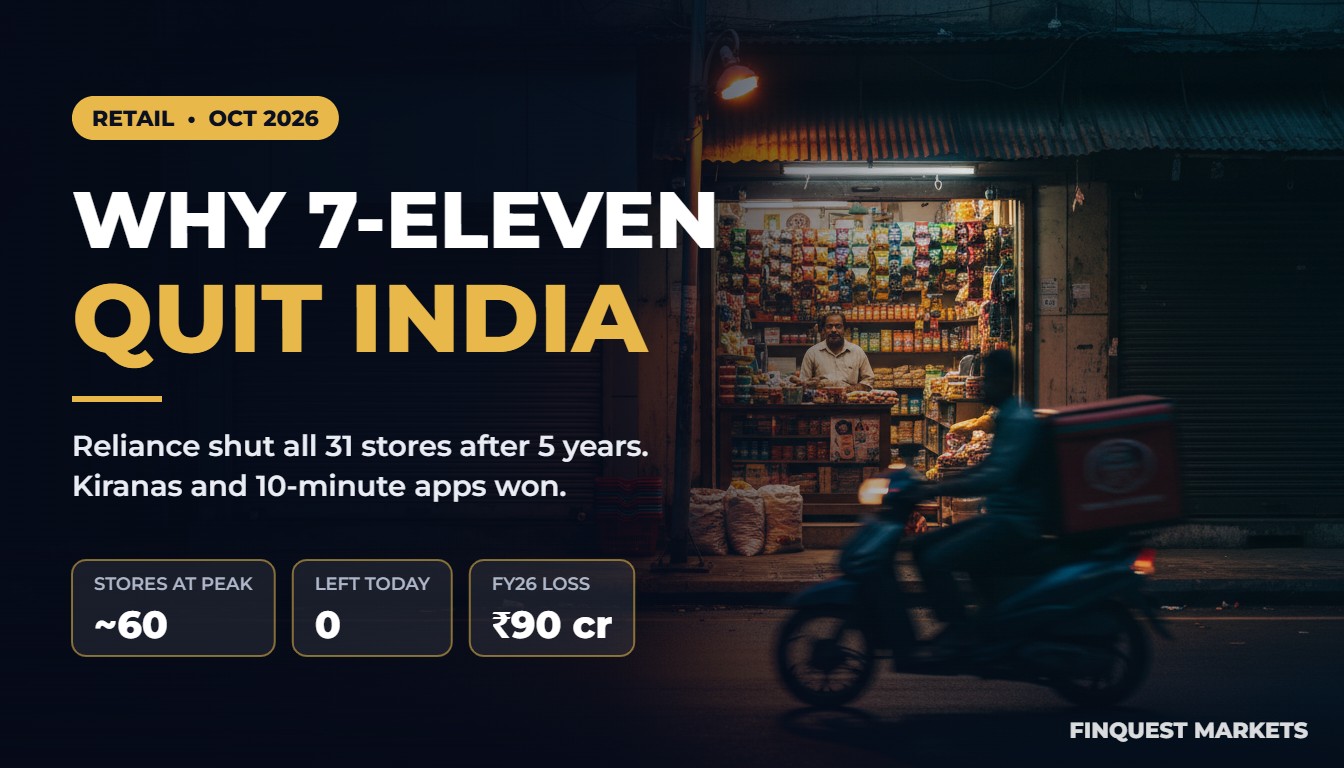
7-Eleven, one of the world’s biggest convenience store chains, has shut every store it had in India. Reliance Retail, which ran the brand under a franchise, closed the last 31 outlets in Mumbai and Pune by 30 September 2026, five years after the first one opened in Andheri East.
On paper this had everything: a global brand, India’s biggest retailer as partner, and a country full of urban shoppers. So why did it fail twice, first with Future Group and then with Reliance? The short answer is that 7-Eleven got squeezed from both sides: the neighbourhood kirana below it and 10-minute delivery apps above it.
Key takeaways
- The exit: Seven & i Holdings, 7-Eleven’s Japanese parent, confirmed all 31 remaining Indian stores closed on 30 September 2026 as the five-year franchise deal with Reliance ended.
- The peak: the network reached about 60 stores, almost all in Mumbai and Pune. Roughly half had already closed before the final shutdown.
- The numbers: in the year to March 2026, the India business made about ₹92 crore in revenue and lost nearly ₹90 crore, as reported by CNBC.
- The reasons: high rents and running costs, a royalty to the brand owner, kiranas that sell the same products cheaper and on credit, and quick-commerce apps that deliver them in minutes.
- For Reliance investors: the impact is tiny. The 31 stores were about 0.15% of Reliance Retail’s network.
Attempt one: Future Group (2019–2021)
7-Eleven’s first Indian partner was Kishore Biyani’s Future Group, which signed the franchise in February 2019 and spoke of opening 1,000 stores in Mumbai alone. Not a single one opened. The joint venture, Future 7-India Convenience, still booked a net loss of ₹17.3 crore in FY21 without a store trading. The deal ended in October 2021 after Future missed store-opening targets and franchise-fee payments, as Future Group itself sank into its debt crisis.
Attempt two: Reliance (2021–2026)
Reliance Retail signed on as master franchisee within days and opened the first store, a two-storey 1,700 sq ft outlet in Andheri East, Mumbai, in October 2021. The chain grew to about 60 stores across Mumbai and Pune but never expanded beyond those two cities, and never came close to the density a convenience chain depends on.
| Metric | Figure |
|---|---|
| First Reliance-run store | October 2021, Andheri East, Mumbai |
| Peak store count | About 60 |
| Stores at closure | 31 (Mumbai and Pune) |
| Last day | 30 September 2026 |
| FY26 revenue | About ₹92 crore |
| FY26 net loss | Nearly ₹90 crore |
The loss was almost as large as the revenue. And even if all ₹92 crore came from the 31 stores open at the end, that works out to under ₹1 lakh of sales per store per day, which is thin for a staffed, air-conditioned shop on prime city real estate.
Why 7-Eleven didn’t work in India
1. The kirana is already a convenience store
In Japan or the US, 7-Eleven fills a gap: there’s no small shop on every corner. In India there is. Neighbourhood kiranas still handle about 91% of India’s grocery sales, according to Redseer, and are expected to hold around 86% even in 2030. They often own their premises or pay low rent, know their customers, give informal credit, and deliver to your door. Most of what 7-Eleven sold, from chips to cold drinks, was available at the kirana next door, usually for less.
2. Quick commerce took the “I need it now” customer
The one customer a convenience store can win from a kirana is the urban shopper who wants something right now. That’s exactly who Blinkit, Swiggy Instamart and Zepto went after. When the same snacks, drinks and essentials arrive at your door in ten minutes, walking to a shop loses its point. 7-Eleven launched in India just as quick commerce took off in the same cities.
3. The costs never fit the format
A 7-Eleven store carries high fixed costs: prime-location rent, round-the-clock staff, a cold chain for fresh food and drinks, and a royalty to the brand owner. The model works when hundreds of stores share one supply chain and each store sells a lot every day. With a few dozen stores in two cities, every outlet carried too much of the overhead.
4. Reliance had cheaper ways to do the same job
Reliance Retail ran about 20,160 stores in FY26, including over 1,000 Smart Bazaar outlets and its own small-format Smart Point grocery stores, which double as pick-up and delivery points for JioMart. JioMart’s hyperlocal delivery draws on more than 3,100 stores and dark stores in over 1,200 cities. Paying a royalty on 7-Eleven made little sense when its own formats chased the same customer at far bigger scale. There’s no evidence Reliance neglected the brand, but it never needed it to win.
What it means for Reliance investors
Almost nothing, financially. Reliance Retail’s gross revenue was about ₹3.70 lakh crore in FY26, and the 31 stores were around 0.15% of its network. A ₹90 crore annual loss going away is, if anything, a small positive. Staff are reportedly being moved into Reliance’s other grocery and neighbourhood formats. The more useful signal is strategic: Reliance is backing its own brands and JioMart’s hyperlocal network over licensed foreign formats.
The bigger lesson: India redefined convenience
Retail consultant Christian Westphal of SilverSpoon Consultancy put it this way to Inside Retail: India hasn’t rejected convenience retail, it has redefined what convenience means. For Indian shoppers, convenience is the kirana that knows your name, or the app that’s at your door in ten minutes, not a branded shop you have to walk to.
That doesn’t mean quick commerce is easy money either. Swiggy’s shares hit a fresh 52-week low this week, and the 10-minute apps are still burning cash on dark stores and discounts. The kirana remains the business everyone else is trying to beat.
Will 7-Eleven come back?
Seven & i has declined to explain the closures but says it still wants to serve Indian customers and is considering several options for a long-term presence. Nikkei Asia has reported the group is now looking to expand in Europe. Meanwhile, rival Japanese chain Lawson is exploring an India entry through a local subsidiary, starting in Mumbai, so the format isn’t being written off entirely. Any return would likely need a very different model from the one that just closed.
FAQs
Has 7-Eleven shut down in India?
Yes. All 31 remaining stores in Mumbai and Pune closed on 30 September 2026, when the five-year franchise agreement with Reliance Retail ended.
Why did 7-Eleven fail in India?
It never reached the scale its high-cost format needs, and it was squeezed by kiranas, which sell the same goods cheaper and on credit, and by quick-commerce apps that deliver them in minutes.
How many 7-Eleven stores were there in India?
About 60 at the peak, all in Mumbai and Pune, falling to 31 before the final closure.
How much did 7-Eleven India lose?
In the year to March 2026 it reported a net loss of nearly ₹90 crore on revenue of about ₹92 crore, according to CNBC.
Does this affect Reliance Industries shares?
Not meaningfully. The stores were about 0.15% of Reliance Retail’s network and the losses are small next to its roughly ₹3.70 lakh crore in revenue.
Sources: Business Standard, Inside Retail, exchange4media, Trak.in, Trade Brains.
Disclaimer: This article is for information only and is not investment advice. Finquest Markets is not a SEBI-registered investment adviser. Please do your own research or consult a registered adviser before investing.



Leave a Reply